Analysis of the Accessibility Advantages of Tracked Mobile Stone Crushing Plants
In modern quarrying and aggregate production, mobility is no longer a luxury—it is a necessity. Fixed crushing installations have long been the industry standard, but they come with a hidden cost: inflexibility. When a quarry expands to a new deposit or a construction project moves to a different valley, stationary equipment becomes a liability. Tracked mobile stone crushing plants(planta de trituración móvil) have emerged as the practical answer to this challenge. Their ability to navigate rough terrain, relocate quickly, and start production within hours gives operators a clear competitive edge. This article examines the specific accessibility advantages of tracked units and why they are reshaping material processing in the mining and aggregates sector.
Why Accessibility Determines Profitability in Aggregate Operations
Accessibility directly affects operating costs. A deposit that cannot be reached efficiently is not economically viable. Traditional wheeled or skid-mounted units often require prepared roads, towing vehicles, and significant setup time. Tracked mobile stone crushing plants eliminate most of these requirements. They move under their own power, climb slopes up to 20 degrees, and operate on soft ground where wheeled machines would sink.
The Terrain Advantage of Tracked Systems
Consider a typical quarry expansion. The new extraction face may sit 500 meters away from the existing crusher location, across uneven ground with loose gravel and moderate grades. A tracked mobile stone crushing plant simply drives to the new position. No road building, no heavy transport trailers, and no crane for assembly. The same principle applies to multiple-site operations. A contractor working on three different highway segments over 12 months can move a tracked unit between sites in a single day.
Here is how tracked mobile plants compare to other configurations:
- Compared to stationary plants – Tracked units require no foundations, no concrete pads, and no overhead crane for assembly. Setup takes hours instead of months.
- Compared to wheeled mobile plants – Tracked plants are self-propelled and climb steeper grades. Wheeled units need a separate tow truck and cannot operate on soft ground or loose gravel.
This comparison shows why a mobile stone crusher plant on tracks is preferred for remote or challenging locations.
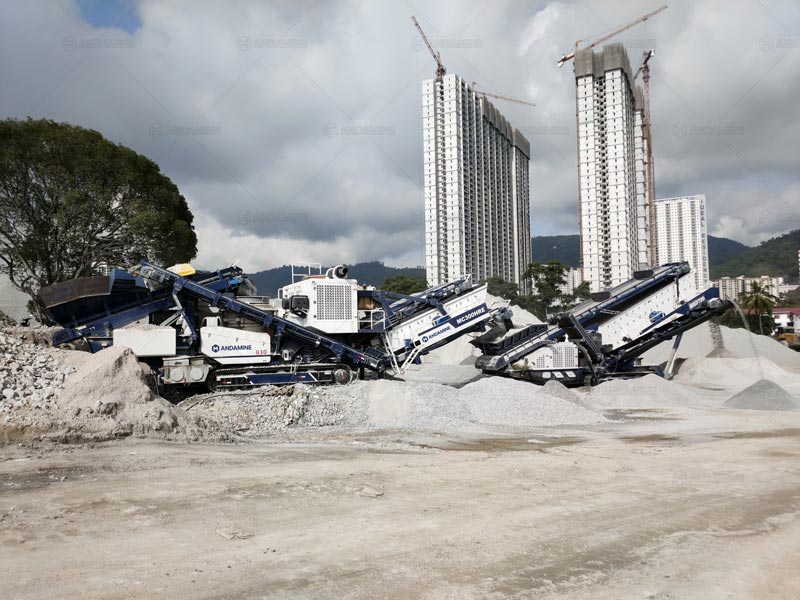
How a Mobile Stone Crusher Plant Improves Job Site Access
A mobile stone crusher plant on tracks integrates feeding, crushing, screening, and conveying into one transportable unit. The tracked chassis provides stability on slopes and uneven surfaces, allowing the plant to operate safely where other equipment cannot.
Direct Access to the Material Face
The most significant accessibility benefit is the ability to position the mobile stone crusher plant directly at the extraction point. Instead of hauling blasted rock hundreds of meters to a fixed crusher, a loader or excavator feeds material directly into the tracked plant’s hopper. This eliminates one or more haulage cycles, reducing fuel consumption and equipment wear.
For example, a limestone quarry with multiple benches can move a tracked mobile stone crusher plant to each bench as extraction progresses. The plant processes material at the face, and a short conveyor stocks finished product nearby. No haul trucks, no road maintenance, and no waiting.
Reaching Confined Spaces
Urban demolition and recycling projects often occur in space-constrained environments. A mobile stone crusher plant on tracks has a smaller turning radius than wheeled units and can maneuver around buildings, stockpiles, and utility lines. Some models fold their conveyors for transport, reducing transport width to under 3 meters. This allows the plant to pass through standard gate openings and work inside demolition zones.
The Role of an Impact Crusher in Tracked Mobile Plants
The crushing chamber itself influences accessibility. An impact crusher(trituradora de impacto) is particularly well-suited to tracked mobile applications because of its high reduction ratio and ability to handle recycled materials. Unlike jaw crushers that require a certain feed size consistency, an impact crusher accepts a range of input materials, including concrete rubble, asphalt, and medium-hard rock.
Why an Impact Crusher Enhances Operational Flexibility
When a mobile stone crusher plant is equipped with an impact crusher, the operator gains two additional advantages. First, the impact crusher produces a more cubical product shape, which is preferred for road base and concrete aggregates. Second, the impact crusher can switch between virgin rock and recycled feed without major adjustments. This versatility means the same tracked plant can work on a highway project one week and a demolition recycling site the next.
A typical configuration includes a vibrating feeder, an impact crusher as the primary or secondary stage, and a recirculating screen. The entire mobile stone crusher plant fits on two or three tracked modules, each self-propelled and independently maneuverable.
Choosing Between Impact Crusher and Other Types
For operators focused on accessibility, an impact crusher offers distinct advantages over jaw or cone crushers. Jaw crushers are heavier and require more stable ground conditions. Cone crushers need precise feed control and are less tolerant of fines or wet material. An impact crusher, by contrast, handles variable feed sizes and produces a consistent product shape even when the material characteristics change. This makes the impact crusher the natural choice for a mobile stone crusher plant that will move frequently and process different material types.
Understanding the Price of Stone Crushers in Tracked Configurations
Budget considerations inevitably arise. The price of stone crushers(precio de trituradoras de piedra) in tracked format is generally higher than wheeled or skid-mounted equivalents, but the total cost of ownership tells a different story. A lower initial price of stone crushers for stationary plants ignores the costs of site preparation, haulage, and lost production during moves.
What Influences the Price of Stone Crushers for Tracked Plants
Several factors determine the price of stone crushers in a tracked mobile stone crusher plant:
- Engine power and emissions tier – Tier 4 Final or Stage V engines add 10-15% to the base price of stone crushers but reduce fuel consumption
- Crusher type – An impact crusher typically costs less than a cone crusher of equal throughput, but more than a jaw-only configuration
- Screening system – Integrated recirculating screens increase the price of stone crushers by 20-30%
- Automation and remote monitoring – Telematics and centralized controls add convenience but raise the initial price of stone crushers
A typical mid-range tracked mobile stone crusher plant with an impact crusher and onboard screen might carry a price of stone crushers between $400,000 and $700,000. For comparison, a stationary plant with equivalent capacity could have a price of stone crushers that is 20% lower, but only if the site already has foundations, power supply, and access roads.
Calculating Return on Accessibility Investment
The accessibility advantages translate directly into cost savings. Consider a contractor who moves their crushing operation three times per year. A tracked mobile stone crusher plant requires one day per move, including transport and setup. A wheeled plant requires two days (one for towing and positioning, one for setup). A stationary plant is not movable. Over three years, the tracked plant saves weeks of downtime compared to wheeled units, and months compared to building new stationary sites. When amortized, the higher initial price of stone crushers for tracked equipment becomes the lower long-term cost.
Practical Applications in Mountainous Regions
The accessibility advantages described above are particularly relevant in mountainous regions like the Andean belt. Roads are narrow, grades are steep, and quarry locations are often perched on hillsides. A tracked mobile stone crusher plant can climb service roads that would defeat a wheeled plant. An impact crusher handles the variable feed sizes common when processing river cobble or weathered mountain rock.
Real-World Example From Aggregate Production
One aggregate producer operating in a mountainous area runs two tracked mobile stone crusher plants on different faces of the same mountain. Each plant moves every three months as extraction progresses. The price of stone crushers for both units was recovered in 18 months through eliminated haulage costs alone. The site manager notes that the impact crusher on each plant processes a mix of hard basalt and softer sedimentary rock without changing wear parts or adjusting settings between shifts.
Key Considerations Before Purchasing
Before investing in a tracked mobile stone crusher plant, evaluate these practical factors:
- Site access roads – Even a tracked plant needs a path to reach the work area. Verify that bridges, gates, and tunnels can accommodate the plant’s transport dimensions.
- Material characteristics – Test your feed material with an impact crusher to confirm production rates and wear life.
- Local dealer support – Ensure spare parts and service technicians are available within your region. A tracked mobile stone crusher plant is only as accessible as its supply chain.
- Resale value – Tracked units retain value better than stationary plants because they can be moved to a new owner’s site easily.
Making the Right Choice for Your Operation
Accessibility is not just about reaching the material—it is about staying productive once you arrive. Tracked mobile stone crushing plants offer unmatched ability to operate on slopes, soft ground, and confined spaces. They reduce or eliminate site preparation costs, shorten move times from weeks to hours, and allow operators to follow the material face continuously.
When evaluating equipment, compare the full lifecycle cost, not just the initial price of stone crushers. A tracked mobile stone crusher plant with an impact crusher may have a higher purchase price, but the savings in haulage, site work, and downtime often justify the investment within the first year of operation. For contractors and quarry owners facing challenging terrain or frequent relocations, tracked mobility is not an upgrade—it is the foundation of a profitable aggregate business.